How Can We Feel We are Part of a Future We Do Not Know?
Artificial intelligence is spreading fast, yet deeper change within organisations is slow. Maybe this isn’t primarily a question of money or expertise, but of who the future seems to be for. Through arts we can get tools for involving people in shaping the future.
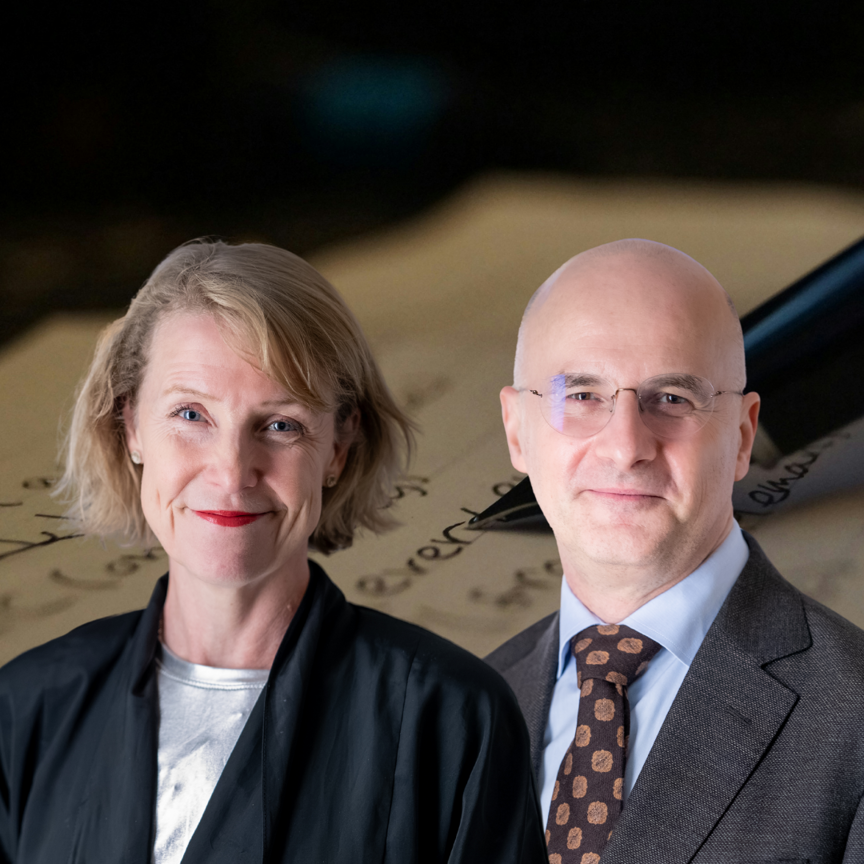
We know remarkably little about what the future will look like. That may sound odd coming from two university leaders who are often asked to say something wise about what our future will be like. Some people seem more certain of where we are heading and describe developments in artificial intelligence as the end of work and livelihoods, perhaps even the end of humanity itself. Others emphasise that the greatest rise in prosperity in history lies ahead of us. We ourselves feel less certain.
The uncertainty is not about whether advances in AI will change our lives, but about where they will lead. Major changes are already here, and they are moving faster than current institutions are able to act. We are told, and at least partly agree, that everyone needs to keep up with the development, and that those who remain on the outside risk becoming irrelevant in general and in the labour market in particular. And yet the transition is slow. Why?
Perhaps funding, knowledge or motivation is lacking. But our hypothesis is different: many people do not see themselves in the future they are being promised. From the frontline of technology, we hear that large parts of knowledge work will soon be done by machines, that occupations will disappear, and that humans will at best be left to supervise something that does the job better than they do. Why would anyone who hears that message repeatedly be eager to put both their professional pride and their security at stake?
It is obvious that AI will be widely used and will change society. How that transition takes place, however, remains an open question. Which tasks are handed over, what people will do instead and what we choose not to automate will be settled in thousands of decisions in workplaces, companies and public authorities. Those who can influence these decisions also have an opportunity to shape their own place in the future. This is when change can begin to feel meaningful.
Two abilities for the future
Earlier this year, we wrote the essay The Two A's in STEAM. STEM stands for science, technology, engineering and mathematics. STEAM adds an A for the arts, understood broadly to include art, design, the humanities and the social sciences. We argued that this A represents two distinct abilities. Hence STEAAM.
The first A is the ability to understand people and the context in which technology is to be used. Who is it for? What does it change, and how is it received? It is about a focus on users that extends from understanding underlying needs and applications of the individual to organising our everyday lives and creating a future society.
The second A is the ability to imagine something that does not yet exist, or to think differently. By giving different futures tangible form as a story, an object, a working day or a spatial environment, we make the unknown something we can explore and respond to emotionally.
The two A’s therefore also have democratic significance. The first helps us take people’s needs and experiences seriously. The second allows the very image of the future to look different and helps us all in facing the unknown. The transition around AI needs to encompass more than the desire of large organisations to become more efficient.
Influence needs to be experienced and felt. Understanding a change intellectually is one thing; experiencing it as something that concerns you personally is another. The climate crisis shows how difficult this can be. Despite extensive research and vast amounts of information, people do not automatically change their behaviour. More facts are not always what is missing.
A concrete example of how co-creation can generate a sense of belonging can be found in the centre of Stockholm. Ernesto Garcia, a doctoral student at Konstfack, noticed that several of the iconic black-and-white paving slabs at Sergels torg were damaged or missing. As part of his work on transition, care and repair, he brought together volunteers, ranging from decision-makers to young people from disadvantaged areas, to cast new slabs. Participants were invited to mix fragments of objects that meant something to them into the material: a beer bottle from a teenage night out, or a piece of their grandmother’s finest coffee cup.
Someone who has contributed a memory and their own work develops a different relationship with the place. Something of their own life now forms part of the city’s shared space. Repairing a public square is, of course, a very different matter from solving the climate crisis, but the example shows how care can grow when people are able to make something together and see their own contribution reflected in the outcome.
One important question we therefore need to ask about the technological transition is this: How can more people experience themselves as participants in shaping what is emerging?
Giving form to the unknown
Participation in today’s transition is only part of the task. New technology also makes it possible to create something entirely different in addition to more efficient versions of what we already have. This is where the second A in STEAAM is needed: the capacity to question today’s solutions and imagine something we have not yet tried. That requires courage, including the courage to acknowledge what we do not know.
People have always given form to the unknown. In fairy tales, myths and legends, diffuse threats have become trolls, monsters and other creatures. They have embodied things that were difficult to understand or talk about: the forces of nature, illness, vulnerability and the unfamiliar. Once fear was given a body, a place and a story, it became possible to approach it. We could explore different ways of responding, and sometimes even outwit what we feared.
We need the same imaginative ability in the face of climate change, technological upheaval and geopolitical instability. Stories allow us to explore what these developments might mean in everyday life. What might we lose? What might we create?
In the book AI 2041, AI researcher, entrepreneur and investor Kai-Fu Lee’s technological foresight is combined with the literary imagination of science-fiction writer Chen Qiufan. Through ten stories and accompanying analyses, they explore how AI may come to shape people’s lives over the coming decades.
In the story The Golden Elephant, a family in Mumbai joins an AI-based insurance scheme. Apps offer advice intended to improve their health and finances, but the system also begins to direct the family’s behaviour and influence the daughter’s love life. The benefits come at a price: surveillance and control.
Quantum Genocide shifts the perspective to threats facing entire societies. Here, quantum technology, vulnerable digital security and autonomous weapons converge. Together, the stories allow us to examine technology’s promises and risks, from the small choices of everyday life to the fundamental security of society.
The idea that machines might surpass human beings and escape our control is an old one. Science-fiction writer Isaac Asimov’s laws of robotics from the 1940s can be seen as an early literary attempt to grapple with what we now call the alignment problem. In Arthur C. Clarke’s and Stanley Kubrick’s 2001: A Space Odyssey, HAL 9000, the spacecraft’s AI system, embodies the danger posed by an intelligent machine when its instructions come into conflict. James Cameron’s 1984 film The Terminator, in the form of its killer robot, embodies the fear that control might be lost altogether.
Those same questions now lie at the heart of the AI debate: dependence on American technology companies, surveillance, vulnerable digital systems and AI agents that behave unpredictably, but also artificial general intelligence and superintelligence. Assessments of how urgent these issues are vary enormously, but risks that could threaten humanity’s future must have a place in any serious conversation about AI. We need to be able to give them form, test the assumptions behind them, and discuss what choices they require us to make today.
Since 2012, Arizona State University has had a Center for Science and the Imagination, where science, technology, art and storytelling are brought together with policymakers and citizens to develop visions of the future that are both inspiring and scientifically grounded. One of its central ideas is that societal problems can also be problems of imagination. If we cannot imagine alternatives, it becomes difficult to mobilise the energy for change.
The arts have long worked with precisely this: giving form to the unimagined so that it becomes possible to think about, to question and to discuss. We need both futures to long for and futures we want to avoid. Looking away from the trolls is hardly going to help us face them.
This also applies to things that lie beyond what we ourselves can comprehend. Susanne Aalto, Professor of Radio Astronomy at Chalmers, studies star formation, massive black holes and cold superwinds in galaxies. Together with Valentin Nash and Jonas Ahnmé from Konstfack, she has explored humanity’s relationship with the universe. Through conversations at Onsala Space Observatory and Nash’s film about black holes, the incomprehensible is given a form that we can begin to approach. At the very least, we understand a little better what it is that we do not understand and develop a relationship to it both intellectually and emotionally.
From possible futures to shared decisions
In Possible Futures, a joint course at Chalmers and Konstfack, we have begun exploring how different perspectives can be brought together. Students develop ideas, concepts and physical objects around possible futures, both utopian and dystopian. They then work backwards to the present and ask: what do we need to start doing now?
One student project imagines the year 2050, when we celebrate “The Last Cancer Day”. It gives hope and allows us to feel what such a future might mean. Another degree project describes a world in which people have lost their cultural heritage, their memory and their ability to write. To pass on knowledge about where radioactive waste has been buried, they have created a religion sustained through oral tradition. The dystopia gives us something concrete to discuss: how technology, memory and society are interconnected.
At the same time, we have launched a series of dialogues around Possible Futures, in which two guests from different backgrounds discuss what the future might hold. It has been a joy to experience the openness and humility towards what we do not know, and it gives us a foundation on which to build.
Changing established structures and working patterns is difficult, whether in administration, healthcare, education or research. Simply demonstrating what a tool can do is rarely enough. Someone who has personally explored the alternatives, however, may find their own reason to learn the technology. The process may also generate solutions that no one had imagined at the outset.
But participation must be genuine. People need to be able to question both individual solutions and assumptions about where development ought to lead. A consultation on something that has already been decided may instead confirm the suspicion that one’s experiences, hopes and fears do not matter. We must collectively ensure that we take these developments seriously and confront the changes they require.
An opportunity for Sweden
Sweden is well placed to work in this way. Trust in other people and in society’s institutions is high by international standards. Hierarchies are relatively flat, and we have a tradition of involving those affected when working life changes.
But trust and security do not automatically lead to renewal. The Swedish model only becomes a strength when we use it to experiment, discuss and make real decisions together. We cannot simply hope that a future shaped by others will have manageable consequences for us, or that somehow we are protected and will not be “affected”. If we want to be at the forefront, we have considerable opportunities to develop ideas and solutions that others have not yet thought of.
That is why we want to build a shared Possible Futures hub, where leading technical and scientific expertise meets art, design, the humanities and perspectives from the social sciences. The future already has its specialists. Think tanks, foresight units and advisory groups develop scenarios and horizon-scanning analyses, often to a very high standard. But the work is done by a small number of people, and for most others the future arrives as a finished report.
Developing visions of the future together is something quite different.
Possible Futures will work in this latter way. Its task is to enable more people to think in terms of possible futures and to become active participants in creating them.
The most important route is through education. Engineers, who will build the technologies that shape the future, need opportunities during their studies to practise imagining where those technologies might lead and what alternatives might exist. Artists, designers, social scientists and humanities scholars need to understand the scale of the major technological shifts we face.
The same approach can be introduced into existing and entirely new educational programmes, into schools and workplaces, and into wider society through public conversations. In the hub, researchers, students, artists, technologists, and leaders from business and the public sector can develop ways of working that refine these methods and test them against real-world questions. Through courses, guest programmes and collaborations, they can then reach far beyond our own institutions.
What we want to create is a shared endeavour in which more and more people see the future as something they themselves have a part in shaping. A collaborative investment in the two As could give this work real momentum.
The responsibility for extending the invitation lies with the leaders of society and our organisations. Each of us has an equally great responsibility to participate and to involve others.
We do not know what the future will look like. Even so, we can begin to explore what kind of world we want to live in and take responsibility for building it together.
About Anna Valtonen and Martin Nilsson Jacobi
Anna Valtonen is Vice-Chancellor of Konstfack University of Arts, Crafts and Design and Vice Chair of the Royal Swedish Academy of Engineering Sciences (IVA).
Martin Nilsson Jacobi is President and CEO of Chalmers University of Technology and a member of the steering committee for IVA’s Swedish Futures project.
Both are members of Sweden’s national STEM Delegation.