Security in a Changing World
How can we foster hope and confidence in Sweden and our future, despite living in uncertain times marked by major and rapid changes? Essay written for IVA as part of Swedish Futures - a vision for Sweden as a country of technology and innovation by 2035 - by Jens Henriksson, Fellow of IVA, Division of Economics.

Security in a Changing World
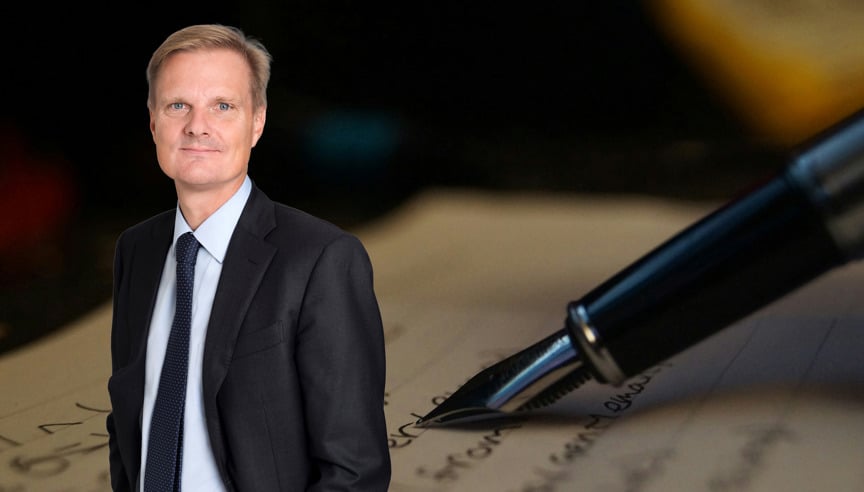
Jens Henriksson, Fellow of IVA
As part of IVA’s vision project Svenska Framtider, I have been asked to write an essay. I do so with great hope and confidence in Sweden and in our future, despite the fact that we are living in uncertain times characterized by swift and major changes. Geopolitics, climate change, tariffs, generative AI, and system-threatening crime are now common topics from kitchen tables to corporate boardrooms.
Sweden's development over two centuries has been characterized by technological progress, democracy and steady improvement in the standard of living. Swedish companies have been world leaders and the Swedish engineer a hero. Our shared journey is remarkable, from a poor agricultural country to an innovative welfare state.
But changes in our world are changing the conditions. The rules-based world order that has distinguished the industrialized world since World War II is now being dismantled. Sweden's future as an industrial nation and welfare state is being challenged.
A new self-driving car in China costs less than 100,000 kronor. Big tech companies in the US are spending vastly more on R&D than Sweden invests in its universities and higher education. Drone development, robotics and AI services are advancing full tilt. What was modern and innovative yesterday may today be outdated and outcompeted. Sweden risks falling behind.

In these times, and with a new playing field, it is more important than ever to agree on the way forward – on a strategic direction för Sweden. Not that of the business sector. Not that of public administration. Not in politics. But for Sweden as a whole.
To begin with, the global context: Due to trade restrictions and regional protectionism, the International Monetary Fund (IMF) has a negative view of the world economy. Instead of seeing free trade as beneficial to all parties, there is an emerging view of trade as a zero-sum game.
The United States is taking protectionist steps unthinkable just one year ago. And autocratic governments around the world are gaining ground. Europe is falling behind. Former European Central Bank chief Mario Draghi has described this as an existential crisis for Europe. And according to McKinsey, Sweden has lost momentum despite substantial investments.
The challenges facing the world, Europe and Sweden are immense.
What can a small and open country like Sweden do? In The Wealth of Nations from 1776, Adam Smith emphasised that the most important thing an individual or a company can do is to act in accordance with their own self‑interest.
This is precisely what Sweden must do – but with an eye on the long term. As a nation, we must improve the conditions for creation of wealth. We need to formulate a framework to drive innovation and growth. All to ensure that we continue to develop. Now. And in the future.
In this way, we can all contribute to a positive development for Sweden and the Swedes, as well as for Europe, the world, and humanity at large, through technological advancement, competition, and leadership – by continuously working for a good and sustainable society. Economics is not a zero-sum game.
Safety and security create the conditions. Sweden, together with our allies, must be able to defend our way of life. Peace and freedom rest on a strong defense and good internal security. Our infrastructure must be stable and resilient.
And it is urgent. Sweden has traditionally had a low tolerance for risk and missteps. When, as now, speed is necessary, we must accept shortcuts and imperfections. Permit processes and procurements must focus more on speed and development than on getting every little detail right.
The macroeconomic framework serves Sweden well. Budget discipline, low government debt and price stability create fertile ground for economic development and greater prosperity. We cannot neglect this. Our institutions in a broad sense are a strong competitive factor for Sweden.
Europe sees Sweden’s well-functioning capital market as a model. Fund and share savings, business angels, venture capitalists, family-owned companies and family business and non-profit spheres, funded pension solutions, and stable and profitable banks distinguish Sweden. The financial market is the lifeblood of the economy, ensuring that capital is allocated via the invisible hand to where it is most useful. We must safeguard this.
The Swedish labour market functions well. Wage increases keep pace with those in comparable countries. But education has fallen behind. Far too many leave school without passing grades. Low expectations undermine Sweden’s long‑term capabilities. Both elite and broad‑based education are equally important. We need both academic and vocational training. Education must pay off.
Sweden’s market for goods and services is part of Europe. The internal market is one of our greatest advantages. Equal treatment and competitive neutrality should distinguish Sweden, and we should always be a driving force for open markets and free trade. Taxes and exemptions that create distortions may seem like a good idea in the short term, but they undermine long-term value creation. Simplicity, transparency and equal treatment should characterise Sweden.
Well-functioning capital, labor, and product markets in a country with a strong macroeconomic framework foster dynamic economic development that promotes growth and prosperity. But this creates considerable pressure for change.
Creative destruction breaks down structures, erodes wealth and renders old jobs obsolete. At the same time, it generates even more prosperity and new jobs. This is nothing new – it has shaped Sweden for centuries.
For the public to continue to accept and embrace this, change must be accompanied by security.
Sweden is unique as a social model. Publicly funded healthcare, free schools and universities, paid parental leave and health insurance, unemployment insurance, and public and funded pension systems all contribute to security in Sweden. This supports the acceptance of new technology and transformation.
Work and action must always be more worthwhile than passivity. At the same time, society must provide more opportunities for retraining and continuing education. The pace of change will quicken, not slow down. The rapid development in the field of AI may, in the coming years, lead to sharply increased needs for retraining programmes and labour‑market policy initiatives.
A small and open country like Sweden, with a competent and well-educated population can do a lot. But we cannot do everything. In some important areas, Sweden is too small. Here, we must build strategic partnerships with our allies. Mutual dependence builds security and predictability.
The Royal Swedish Academy of Engineering Sciences (IVA) has analyzed 48 strategic technology areas based on scientific publications, patents, and public venture capital investments. Based on this analysis, Sweden must dare to choose and prioritize. Not by picking winners - that is the role of the market - but because, as a small country, we cannot spread our resources too thinly.
Let this be a process characterized by competition and open testing. We may not know where this will lead, but it is no long shot to say that our base industry form the basis, and that innovation and technological development will play a role. It goes without saying that this must be carried out with consideration for the environment and our planetary boundaries. All based on the premise that it is profitable and productive to be sustainable.
I believe in Sweden. But Sweden needs a clear strategic direction.
The basis is a stable framework. Sweden should have flexible and dynamic markets. Sweden should focus on education and skills – and dare to prioritize. Security in change with strong driving forces makes Sweden entrepreneurial and innovative.
Just as the Nordic Swan ecolabel prompts me to choose the right dishwashing liquid, I want to see “Made with/by/in Sweden” become the mark that makes everyone choose our products and services.
The “Sweden stamp” should stand as an expression of a modern and sustainable Sweden – firmly rooted in our 200 years of technological progress, democracy and improved living standards.
A great country in which to live and work.
Jens Henriksson, Fellow of IVA
About Jens Henriksson
Jens Henriksson holds degrees in engineering and business administration and was awarded a licentiate degree in economics from Stockholm University in 2012, with a thesis on the interplay between fiscal and monetary policy.
He has been a fellow of IVA’s Economics Division since 2012.