Europe's role in the "Age of Electricity"
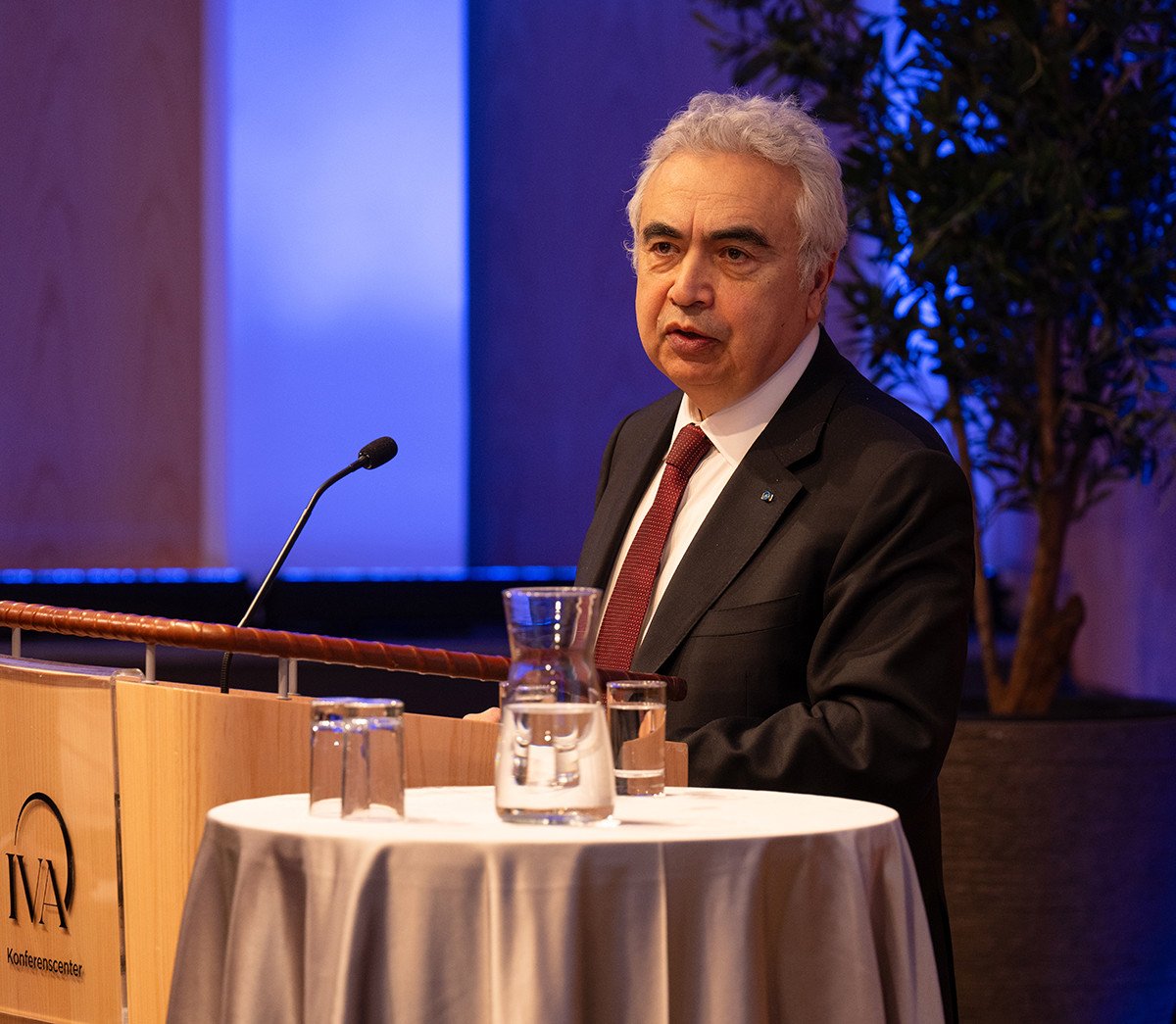
Fresh figures show that global electricity demand is accelerating, and that the world is standing on the threshold of "the age of electricity". This presents Europe with an opportunity to reclaim its leadership in the green transition and to secure its future — a chance we cannot afford to miss. That was the message from Fatih Birol, Executive Director of the International Energy Agency (IEA), during a fully booked seminar at IVA.


"This is not a choice; this is imperative for Europe. If we want to be prosperous, if we want our security, we have to electrify our economies.”
Fatih Birol
That was the message when IEA Executive Director Fatih Birol spoke to several hundred researchers, politicians and representatives of the business community during a recent visit to IVA.
In recent years, the world has undergone a profound transformation, in which the political, economic, technological and military landscape has been reshaped. The ability to achieve a green transition and to electrify society has been identified as one of the most critical factors for maintaining future prosperity, technological leadership, long-term resilience and national security.
Record-breaking Growth in Global Demand
According to IEA's latest survey of major global energy trends, Global Energy Review 2025, the global demand for electricity is increasing faster than ever before. Over the past fifteen years, the demand for electricity has grown at twice the rate twice of overall energy demand. In the record year of 2024, a peak was reached as global electricity demand rose by 4.3 percent. Forecasts indicate that the upward trend will continue in the coming years, albeit at a slightly slower pace.
"We have never seen global electricity consumption increasing so fast. It is driven by three new additional factors. Numbr one is artificial intelligence and data centers. Number two, electric cars and trucks — growing not only in Europe and China, but around the world."
The third and strongest driving force, according to Birol, is the rising demand for air conditioning, which is increasing rapidly worldwide in line with the accelerating climate change.
"So all these three combined – AI, electric vehicles and air conditioning – mean that we can now say we are entering the age of electricity."
A Long Road Ahead for Europe
Within the EU, concerns are growing that Europe as a region has fallen behind and lost its economic and industrial competitiveness. During his address at IVA, the IEA’s Executive Director highlighted three energy policy mistakes which he personally believes have contributed to this development. The first concerns Europe's many years of increasing dependence on Russia as a supplier of natural gas. The second is that we turned our backs on nuclear power. And third, that we relinguisehd our leadership in solar energy technology.
"Today, of all the new power plants built around the world last year, two-thirds consisted of solar panels. Eighty-five per cent of these solar panels were manufactured in China. But if we look back 25 years, it was Europe that set the ball rolling. Italy, Spain and Germany lddrove the development forward through subsidies. Then Europe dropped the ball and allowed China to take it forward. Today they are the leaders," says Birol, who believes that the strategic mistakes he argues Europe has made in recent decades can be corrected—and that electrification is the path forward.
"But, I'm sorry to say it, we are far from being there."
Simplify, simplify, simplify!
According to Birol, there are several areas in which Europe must invest in in order to regain its leading role in the green transition and safeguard its competitiveness as we move towards an electrified future.
"We need to simplify, simplify, simplify," he argues.
Today, the IEA’s Executive Director considers Europe's industrial climate to be characterised by complex regulations and slow processes, making it easier and cheaper for companies to produce in other parts of the world. Birol also calls for a shared strategy—an industrial “master plan”—that would bring all European countries together to pursue shared and strategically important objectives. History offers many examples of what can be achieved when this happens, he argues.
"On the occasions in history when we have succeeded in uniting around a common strategy, we have seen how successful Europe can be."
Among other things, he points to how, over the past twenty years, we have managed to navigate everything from global financial crises to the Covid-19 pandemic and the halt in Russian gas supplies—without “the lights going out”.
To take the lead in an electrified future, the common master plan Birol calls for would need to address questions such as:
- What is required to strengthen the competitiveness of industries that already exist?
- In which new technological fields—crucial for building an electrified society—do we still have a good chance of competing globally?
- How can we secure the raw materials and partnerships that we will depend on in order to succeed?
“We must choose our battles, and there are areas where the train has unfortunately already departed. It may no longer be feasible to reinvest in solar panel production, but there may be other cleantech areas—offshore wind power, for example—where we still have the potential to become strong,” says Birol.
A Crucial Factor for an Electric Future
Despite the long road ahead, and despite developments moving much faster in many other parts of the world, Birol wants to remind us of the strengths Europe possesses—assets that can be used to reclaim a leading role in electrification.
“Europe remains the world’s second-largest economy, with over 450 million consumers. It is also one of the world’s largest export regions and a centre for research, innovation and patents. We have several countries that have made significant progress in their electrification—for example Sweden, which can lead the way for others. In addition, we already have well-established industries producing many of the components the rest of the world needs for its electrification: power grids, transformers, electrical cables and electrical equipment—areas in which we can invest even more. But we have been a bit slow.”
In the end, however, there is one decisive factor that Fatih Birol emphasises as absolutely fundamental if Europe is to succeed in stepping into an electric future: a major joint effort is needed to build a resilient energy system capable of delivering reliable, affordable and renewable electricity. Without this, there will be no European competitiveness, he argues.
"The time is now! And I believe that all countries in Europe—including our colleagues in Brussels—agree that we must push the button to make Europe's future electric," says Birol.
Facts
In 2024, global electricity demand increased by 4.3 per cent. Between 2010 and 2023, the average annual increase was 2.7 per cent. In 2026, it is expected to reach around 3.7 per cent. (Source: IEA).
The International Energy Agency (IEA) is an independent organisation with 32 member countries. It compiles statistics and conducts analyses and forecasts on global energy sector developments. The IEA’s mission is to “work with governments and industry to shape a secure and sustainable energy future for all”.
Dr Fatih Birol is an economist and energy expert, and since 2015 the Executive Director of IEA. Birol also chairs the World Economic Forum (Davos) Energy Advisory Board. He has been included in the TIME100, TIME's annual list of the world's most influential people, and named by Forbes as one of the most influential people in the world of energy. Prior to joining the IEA, Dr Birol worked at the Organisation of the Petroleum Exporting Countries (OPEC).
Birol earned a BSc degree in power engineering from the Technical University of Istanbul and received an MSc and PhD in energy economics from the Technical University of Vienna. He has been awarded an honorary Doctorate of Science from Imperial College London.