IVAs President - Some thoughts on Surviving Chaos
Dear Friends of IVA,
How do we survive chaos? That question came up last month in a discussion in London, where the founder of the European Council on Foreign Relations, Mark Leonard, presented his latest book, Surviving Chaos: Geopolitics When the Rules Fail.
Had the conversation taken place a decade ago, it would have been entirely different. Back then, the world – at least for us in Europe – was a different place. The UK was still an EU member, Obama was in the White House, and a massive free trade agreement – TTIP – was being negotiated across the Atlantic. Russia had, admittedly, annexed Crimea, but I would say that we at that time did not fully understand (and perhaps turned a blind eye to?) Putin’s expansionist intentions. Nor did we understand Beijing’s plans to dominate the world technologically and economically over the next 5–10 years, even though those intentions had been clear and stated long ago. Were we naive? Probably. Or perhaps we simply couldn’t grasp what was about to happen, just as Chinese bureaucrats in the Qing Dynasty (1644–1912) failed to react when Europe’s technological development exploded. They were accustomed to working with continuous and incremental development and constantly building upon existing systems and models, not dealing with system-changing disruption.
According to Leonard, the chaos we see in the world today should be viewed as a state of “un-order,” rather than “dis-order.” A world characterized by un-order is one in which an order exists, but the rules are being broken. Dis-order, on the other hand, means that the rules are irrelevant and completely ignored.
We find ourselves in a world without a shared understanding of what is right and wrong, where the superpowers disregard the rules. I believe we should view this era as a very painful state following a long period of predictable and reasonably stable conditions. To borrow a phrase from Gramsci: “The old world is dying, and the new world struggles to be born: now is the time of monsters.”
Earlier this spring, the European Commission published the book, Capitalism, Sustainability and Democracy – Future Proofing the European Model, in which we authors argue that today’s geopolitical chaos is actually several different crises occurring simultaneously, caused by the relationship and tension between the capitalism, sustainability, and democracy of the new era.
Leonard makes a similar argument. He believes that the current crisis is a polycrisis. This new situation is being caused by intertwined structural factors, which he insightfully calls the 4Cs: capital, climate, chips, and civilization. Put simply: economy, climate, technology, and security.
How can we learn to live—and even thrive—in this chaos? Those of you who regularly read my writings know that I am not nostalgic. If the old order no longer exists, Europe has very little to gain by standing on the sidelines and arguing for its restoration. Either we can stubbornly try to restore what has been lost (mutually agreed-upon rules and stable institutions), or we can act like China – more long-term, more pragmatically – and maximize our own freedom of action. In all of this, Europe’s ability to keep up with, and even drive, technological development will be crucial – for the economy, for sustainability, and for the security of the society we want to live in. I’ve seen some positive developments on that front in recent weeks, both for Sweden and the EU. The EU is expected to present a semiconductor strategy in the coming days (Chips Act 2.0), while IVA has released a corresponding report for Sweden on where we stand in the area of semiconductors and what we should do going forward. The Swedish venture capital firm EQT has been selected to lead the EU’s Scaleup Fund. And Sweden has signed a technology cooperation agreement with the United States.
As an economic historian, I often look back at history to interpret the present and understand what may lie ahead. In 2014, the American scholar and Wall Street Journal columnist Walter Russell Mead wrote a widely noted article in Foreign Affairs, which today, twelve years later, feels even more relevant. In “The Return of Geopolitics,” Mead describes a world where power politics is once again central and where great powers openly flout the rules. He argues that the West seriously misjudged what the fall of the Soviet Union and globalization meant for the behavior of states. I am inclined to agree. We are now seeing the result of this.
I do not believe that the major dividing line going forward will be between democracies and dictatorships. Instead, we will see a world consisting on the one hand of countries that can adapt and take advantage of the new world unorder and, on the other hand, countries that stand helplessly by and wonder what happened. A wise person close to me put it rather bluntly: “China thinks long-term and acts swiftly. Europe thinks short-term and acts sluggishly.” Perhaps there is some truth to this?
European leaders would do well to understand that the old order is over. This doesn’t have to mean accepting chaos or the survival of the fittest or giving up on democracy. Instead, European actors need to develop a new framework that suits Europe now and in the future: our own version of pragmatic freedom of action – more agile and more experimental, yet strategically long-term. But at the same time, we must not compromise our values. We’ve done this before. The 1950 Schuman Declaration outlined a Europe built on practical solutions that gradually created a new order. Is it time for a new Schuman Declaration, in 2026?
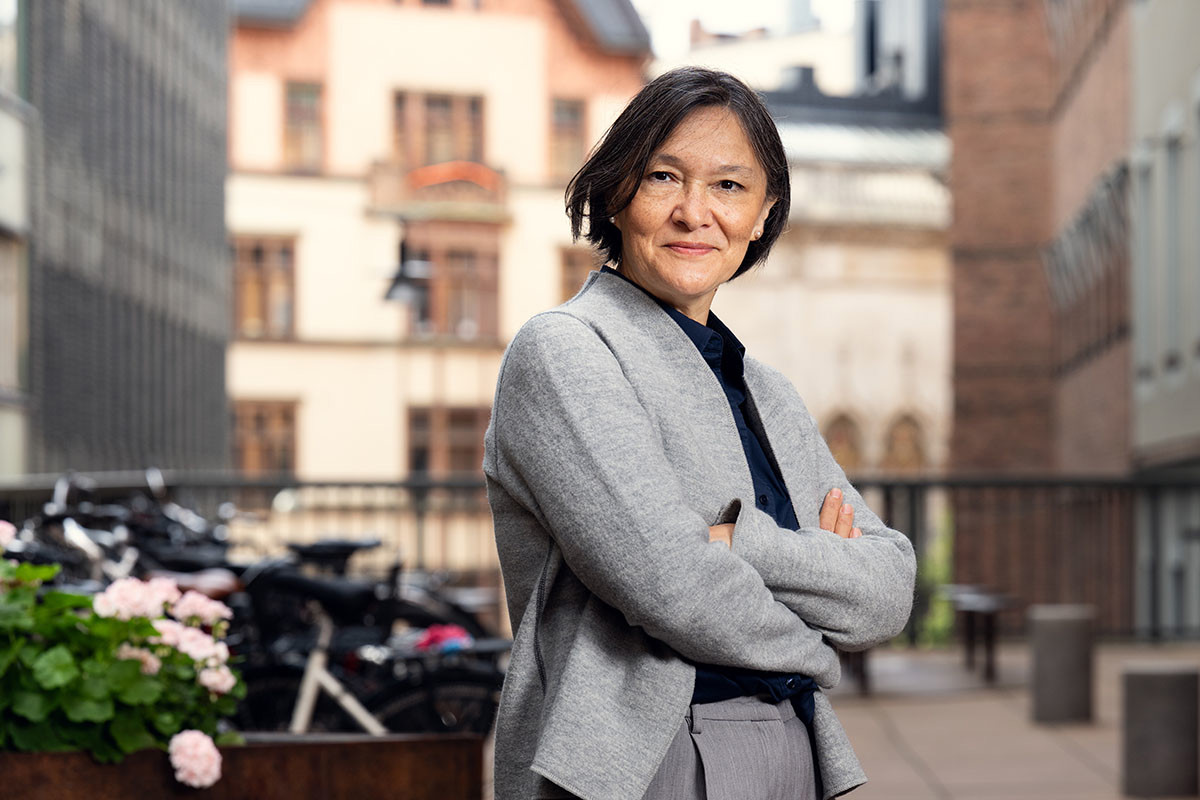

Thank you for being part of IVA's network!
/Professor Sylvia Schwaag Serger, President IVA