The Two As in STEAM
A vision of art, design and the humanities as the Nordic region’s next competitive advantage. Essay written for IVA as part of Swedish Futures - a vision for Sweden as a country of technology and innovation by 2035 - by IVA Fellows Martin Nilsson Jacobi and Anna Valtonen.

The Two As in STEAM
A vision of art, design and the humanities as the Nordic region’s next competitive advantage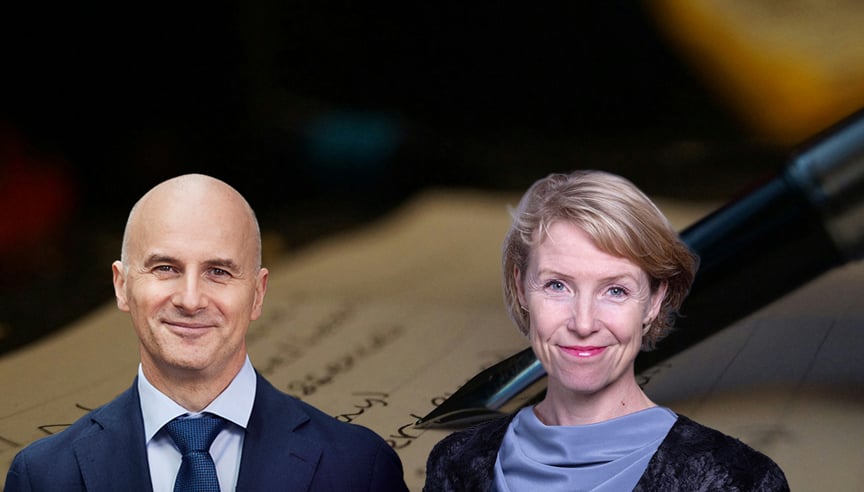 Martin Nilsson Jacobi, rektor och verkställande direktör Chalmers tekniska högskola och Anna Valtonen, rektor Konstfack.
We Have Always Known the Secret
There is a story about Sweden as a nation of innovation that is not told very often. It is not a story about patents and engineers, nor about export surpluses and manufacturing processes. It is a story about something more elusive — about how, almost without noticing, we have built one of the world’s most successful innovation cultures on a foundation that is as human as it is technical.
Consider what IKEA really sells. It is not furniture. It is a vision of what a good life can look like — accessible to everyone, designed with a democratic conviction that runs deeper than any product catalogue. Consider Spotify: not a technology company in the traditional sense, but a company that understood how music feels, how people discover, share and remember. Consider Volvo, whose safety philosophy was not merely an engineering achievement but a fundamentally humanistic stance: a vision that a vehicle should never cost a life.
The success lies in the ability to unite the technical with the human, the rational with the emotional, the possible with the meaningful.
And perhaps this is precisely what we are trying to articulate when we talk about STEAM. The concept itself is simple enough: it is STEM — science, technology, engineering and mathematics — with an added A, for Arts: art, the humanities and design. Yet the addition of this single letter carries a deeper meaning than merely expanding STEM with additional disciplines. It represents an acknowledgement that technical expertise alone is not sufficient to address the most complex challenges of our time.
It is an attempt to name something we have long known but rarely been able to articulate: that major breakthroughs rarely occur at the centre of disciplines, but rather in the tension that arises when different ways of understanding the world meet. In this sense, STEAM is not a new idea. It is a new language for an old insight.
STEM Built Yesterday’s Sweden. STEAM Builds Tomorrow’s.
The examples above — IKEA, Spotify, Volvo — show that Sweden has, in practice, already created successful innovations by combining technology with design, culture and human understanding. Yet these successes have largely emerged despite, rather than because of, our education and innovation systems. The design-driven, human-centred approach has never been systematically integrated into how we educate, conduct research, or invest.
For decades, STEM — Science, Technology, Engineering, Mathematics — has been the obvious compass guiding the organisation of our education system and innovation policy. It is a framework that has served us well. Today, Sweden ranks as the EU’s leading innovation nation and among the very top globally. This is a legacy to be proud of.
But a legacy is not enough. We are living in a moment of profound technological breakthroughs, such as artificial intelligence, that will reshape our entire economy and society. In this context, the question shifts. It is no longer primarily about producing more people with the right technical skills. AI will increasingly be able to perform many of the tasks that currently define an engineer’s everyday work.
This is where the A comes in — not as a soft addition to a hard core, not as a cultural ornament to a technical framework, but as a competence that is as fundamental as mathematics itself. The Arts — art, design, the humanities and social sciences — provide us with the tools to ask questions that do not yet exist within the system. They train us to see what is not immediately visible, to imagine what does not yet exist, and to understand that every technical solution is always embedded within a context of human values, cultural expectations and historical patterns.
When we have discussed this in various forums — whether within the national STE(A)M delegation, in conversations about Sweden’s futures, or across different Swedish innovation and research arenas — it is rare for anyone to argue that the A is unnecessary. What is less clear, however, is how to articulate what a deeper understanding of the A would mean in practice.
The more we have reflected on this together, the more we have come to believe that this uncertainty may stem from the fact that Sweden does not need just one A, but two. When we attempt to accommodate all aspirations within a single concept, it risks becoming so broad that it ultimately loses meaning or practical applicability.
From our perspective, the A in STEAM can therefore be understood through two distinctly different lenses. Both are necessary, but they require fundamentally different approaches. The first A focuses on the user — whether human or another species — on creating a society in which new technologies are given context and real impact. The second A focuses on thinking entirely differently: on imagining that which does not yet exist.
The First A – Understanding the Human We Are Building For
There is a reason why the most impactful innovations do not emerge solely from laboratories with the right equipment, but also from encounters with the right questions. These questions may concern who a solution is for, and what it changes in their lives.

Major technological shifts and breakthroughs are not only about the technology itself, but also about the societies they create, what they enable, and the consequences they may bring.
This is what the first A is about. It is an A that requires ethnographic curiosity — the ability to truly observe and seek to understand, rather than merely measuring what is easy to quantify. It demands a human perspective in the deepest sense.
When we speak of design, we do not mean design merely as form-giving, but as an empathetic method: the ability to enter another person’s world and emerge with an insight that fundamentally changes what is being built. When we speak of culture, we refer to the expressions, values, knowledge, habits and meanings that are shaped and shared by a group of people. Culture encompasses both what we do and what we believe, as well as the symbols, stories and practices that provide context and meaning in our lives. The first A requires an understanding of how social structures function, how trust is built and eroded, how change is met with resistance — and how that resistance can be transformed into participation.
When technological shifts succeed, they often appear self-evident in hindsight. One such technology in our everyday lives today is the refrigerator. The technical concept was presented as early as 1922 by Baltzar von Platen and Carl Munters in a widely noted graduation project, and Electrolux’s visionary founder, Axel Wenner-Gren, recognised its potential, acquired the rights to the invention, and employed the young engineers.
Axel Wenner-Gren also early on understood the importance of design. In the mid-1930s, he approached the renowned French-American designer Raymond Loewy and commissioned him to design a refrigerator, both inside and out. The result was the Electrolux refrigerator model L300, launched in 1940. Its streamlined form was groundbreaking, expressing modernity and progress. The refrigerator became an icon of the modern home and a major commercial success in Sweden and across Europe.
Raymond Loewy subsequently received further commissions from Electrolux to design floor polishers, vacuum cleaners and accessories. Even the typeface and layout of the Electrolux name were designed by Loewy and his colleagues. Today, we regard refrigerators as a natural part of everyday life, rarely reflecting on the fact that they represent a major technological innovation that has fundamentally changed how we live and prepare food.
Today, AI and automation are increasingly integrated into our daily lives and working environments. Yet in many cases, this still involves doing familiar things with new technology — and not everyone has yet come along for the journey.
We also live in a globally digitalised world, while at the same time witnessing a growing epidemic of loneliness. We have more connections, but fewer deep relationships. We enjoy the longest life expectancy in history, yet stress, depression and obesity are increasing. Meaning, individualism and self-realisation are central, with consumption and identity closely intertwined. And amid all this emerges the paradox of infinite choice — around climate change, AI, information overload and a growing sense of meaninglessness that increasingly shapes the lives of young people.
We are thus surrounded by a world of major transformations, marked by geopolitical uncertainty and profound global challenges. China is building its technological advantage through data and strong political control. The United States is characterised by large corporations and a growing crisis of trust in established institutions. Meanwhile, India, Canada and South America are seeking their roles in international competition. By 2050, 43 per cent of the world’s young people will live in African countries — a development that will likely transform our universities in fundamental ways. Where, then, do Sweden and Europe wish to position themselves in this landscape?
In a country like Sweden, where societal trust is among the highest in the world and is regarded as an economic asset, we can build a collective capacity for change. We can develop new solutions and approaches that take their context and users into account. We can create hope, and a shared understanding that we are capable of shaping our surroundings.
Innovations that fail to understand the context in which they are introduced do not merely fail commercially — they risk undermining the very trust on which they depend. Anyone seeking to build the welfare technologies of the future, the public services of tomorrow, or the workplaces of the future must possess the competence to understand the people who will live with the outcomes — and to help create a world that brings them joy.
In a time of uncertainty, caught between major powers, this also represents a distinct European strength. The EU’s tenth framework programme for research and innovation (FP10), which will succeed Horizon Europe for the period 2028–2034, is currently under development with a strong focus on strategic autonomy, industrial competitiveness, and a structure that places human needs, inclusion and societal wellbeing at the centre of innovation. In many countries, concrete investments in this direction have already been made. In Finland, Aalto University was founded in 2010 through the merger of the Helsinki School of Economics, the University of Art and Design Helsinki, and the Helsinki University of Technology. The idea was to create a new innovation university that would combine art, technology and economics. Each field has its own intrinsic value and research tradition, but new perspectives do not emerge from any single competence alone — they arise when multiple competencies come together. Engineers and economists are needed, as are designers and artists — and many more besides.
The Second A – Imagining What Does Not Yet Exist
There is also another A — and it is more radical. It is not about understanding the world we live in; it is about imagining worlds we have not yet seen.
Creating innovations that become a meaningful part of everyday life may seem straightforward when we speak of a refrigerator, and perhaps manageable when we talk about integrating AI and large language models into daily routines. But what kind of everyday life are we creating for the future when it comes to integrating exponentially increasing computational power, new computing architectures such as neural networks, physically embedded artificial intelligence, gene editing, designed mRNA molecules as biochemical building blocks, or manufacturing based on biological processes?
AI is accelerating research in the life sciences. Quantum computers will simulate materials and biomolecules in ways classical computers never can. Nanomaterials enable better batteries, making the energy transition possible. Vast numbers of sensors provide AI with enormous volumes of real-time data, while space-based sensors enable precise planetary monitoring. These interactions are not additive — they are multiplicative. They create capabilities that could not be predicted from their individual components.
Historically, every qualitative transition has been based on emergent system properties that could not be anticipated from the parts alone. That is precisely what we are witnessing today. But there is a crucial difference: for the first time in history, we are not merely passive participants in emergence. We are creating it deliberately. We design materials atom by atom. We edit genomes base by base. We train intelligences token by token. This represents a fundamentally new position for humanity in the history of the universe.
We are living through a historical moment in which the most decisive innovations are not incremental improvements of what already exists, but entirely new ways of thinking and acting. These lead to behavioural change and require systemic transformations that redefine the rules of the game. The climate transition does not merely require cleaner energy — it demands new materials, new business models, and new norms for what prosperity means. The AI revolution does not merely require better algorithms — it requires an entirely new framework for how we understand work, responsibility and human identity. These are questions that cannot be answered by technology alone, because they are fundamentally connected to deep human behaviours and needs, and give rise to philosophical, cultural and ethical challenges. Critical thinking and an honest search for truth therefore become increasingly important, even when they are uncomfortable and create friction within today’s systems and structures.
The second A is the force that makes it possible to think in these terms. It is the A that art has always mastered: the ability to give form to what does not yet exist, to shape the unthinkable and thereby make it thinkable. It involves identifying new relationships and being able to operate under complex and unpredictable conditions.
Today, seeds of this way of thinking can be found in various places. There are individual collaborative projects, research fields such as transition research or futures studies that are already interdisciplinary and future-oriented, as well as different types of think tanks, institutes and initiatives that attempt to engage with the unpredictable.
A particularly inspiring example is the Santa Fe Institute in New Mexico, founded in 1984 with the explicit purpose of studying complex adaptive systems across disciplinary boundaries. The Santa Fe Institute was created out of the insight that increasing specialisation within science needed to be balanced by synthesis — an environment in which physicists, biologists, economists, computer scientists and humanists work side by side to understand emergent phenomena that cannot be explained by any single discipline alone. The Institute’s organisational model — with few permanent positions, an active visiting programme, and a large group of externally affiliated researchers — is deliberately designed to ensure a constant flow of new ideas and perspectives.
Too often, our structures and processes are still shaped by the needs of previous eras. How, then, do we create opportunities to develop entirely new educational programmes or research approaches that fall outside existing structures or disciplinary frameworks — and that foster genuinely new ways of thinking and acting? This is essential for building long-term excellence, even though such approaches are often labelled “interdisciplinary” or “experimental” today.
When the EU’s New European Bauhaus initiative was first launched, it represented precisely such an attempt. It was an initiative that did not settle for optimising the green transition, but instead asked what a sustainable society should aspire to be, look like and feel like. The aim was to provoke emotional engagement, shift existing perceptions, and create empathy around our shared future challenges. It was also an attempt to establish an active form of future-oriented policymaking.
The challenges the interdisciplinary and cross-sectoral programme has faced in recent years, including questions around its future positioning within competitiveness-driven frameworks, also illustrate that even when the ambition exists, it is not always easy to challenge established structures.
Despite the difficulty of questioning existing systems, we have both arrived at the same insight through our respective international contexts: the individuals who are willing to challenge conventions, create something new, and generate insights across boundaries are among our most exceptional and excellent talents. They are not driven by a desire to defend their own field or personal prestige, but by a commitment to expanding our understanding of who we are and what we can become — together with those who are also willing to question their own ways of thinking.
These individuals are rarely bound to a single discipline or a specific geographical region. Instead, they are drawn to environments where it is possible to think differently. Such environments are typically characterised not only by ambition, but also by diversity and access to resources. If we want to strengthen Sweden for the future, it is essential that we build environments that attract these individuals and give them the opportunity to explore what we cannot yet fully define.
A Future Worth Building
Sweden has all the prerequisites to become the nation that shows the world how STEAM can be translated into practice. We have world-leading technical research. We have a vibrant design tradition with international reach. We have higher education institutions of high quality across technology as well as the arts, humanities and social sciences. We have a labour market culture characterised by trust and collaboration.
What we lack is the deliberate connection — the national vision that allows these strengths to reinforce one another rather than exist in parallel, within separate system logics, rarely in genuine dialogue.
By many international measures, Sweden already ranks among the very top innovation nations. In the EU’s European Innovation Scoreboard 2025, Sweden is designated an “Innovation Leader”, ranking first among EU Member States. In WIPO’s Global Innovation Index 2025, Sweden ranks second globally and has done so consistently for several years. But top rankings are not the same as a frictionless innovation system.
The EU’s country profile for Sweden points out that despite strong framework conditions and very high levels of investment and innovation activity, outcomes are mixed. Among the most prominent relative weaknesses identified are labour mobility for science and technology professionals, resource productivity, and public support for business R&D. Sweden has weak resource productivity in an EU comparison, while simultaneously ranking highest in production-based carbon productivity. This suggests a pattern: we can be technologically advanced and relatively climate-efficient, yet still struggle to make materials, processes and systems connect in ways that scale.
A well-structured country is, of course, an asset. But existing structures can also become obstacles in a time that demands change — both necessary and intentional.
The IMF highlights a different, more long-term tension. Sweden’s labour productivity is among the highest in Europe, but productivity growth has weakened since the global financial crisis. The IMF points to barriers to resource reallocation between sectors and firms as part of the explanation. When a country is already at the frontier, it is often precisely these mechanisms that determine the future: how quickly new ways of working spread, how effectively resources move to their most productive uses, and how innovation travels from the cutting edge to broader adoption.
During a recent visit to Brussels, our Swedish delegation was asked why Sweden is so strong in innovation, yet underperforms in integrating human perspectives. There was a clear demand for Sweden’s national vision for how this dimension is incorporated into competitiveness thinking.
It is within this reality that we wish to position STEAM — not as a new label for creativity, and not as a call to replace STEM with something “softer”, but as a way to strengthen Sweden’s innovation capacity precisely where it is often most vulnerable today: in impact, adoption and systemic change.
The point is not that Sweden lacks art, design, the humanities or the social sciences. The point is that the connection between these perspectives and our technical education programmes, research environments and innovation policy instruments is often ad hoc, project-based and dependent on individual initiatives, rather than systematically embedded.
How we choose to address this is a strategic decision. Finland chose to build Aalto. South Korea chose to make STEAM a matter of national policy. These choices shaped institutions, educational pathways and innovation cultures that are now bearing fruit. Sweden can make its own strategic choices.
We should also not underestimate the individual entrepreneurial pioneers who are already driving this kind of boundary-crossing innovation. But we cannot continue to rely on the chance that the right people happen to meet in the right corridors. The integration of technical, artistic and humanistic perspectives must be designed as the norm — not as the exception.
This does not mean turning engineers into artists, or artists into engineers. It means creating environments where they meet early enough to genuinely influence what is built and why — not late enough to merely shape the surface. It means giving the questions that guide innovation access to more ways of sensing and understanding the world. Sweden already possesses the competencies we are talking about — we simply need to treat them as a core.
The countries, companies and institutions that will shape the coming decades will not necessarily be those with the most advanced technology. They will be those that understand what technology is for. Those that can see one system — and imagine another. Those that know that the hardest innovation is not about what is possible, but about what is worth wanting.
That is, ultimately, what the two As in STEAM are about. The first A gives us the ability to understand the people and the society we are building for — and thus to build correctly from the outset. The second A gives us the ability to imagine futures we cannot yet see — and thus to build towards something that is truly worth reaching.
What Do We Want to Do?
How, then, do we integrate human-centred and questioning perspectives into our innovation and research policy — and build a Swedish future in which people want to live and feel a strong sense that they can influence their own futures in meaningful and joyful ways?
With regard to the first A — the focus on the user and on creating a society in which new technologies are given context and real impact — this is about integrating this way of thinking and working into existing programmes and initiatives. Sweden already has a research and innovation policy that defines the ambition to be one of the world’s leading research and innovation nations and a knowledge leader.
We have also identified eight strategic research areas: Health, life sciences and artificial intelligence; Quantum technologies; Polar research; Climate-related research; Crisis preparedness and total defence; Practice-oriented professional research on crime; Excellence in schools; and Research on advanced materials. In addition, the Government’s research and innovation bill for 2025–2028 — “Research and innovation for the future, curiosity and benefit” — has launched a large-scale investment in excellence clusters for breakthrough technologies. Vinnova and the Swedish Research Council have been tasked with establishing up to five world-leading excellence clusters in strategically important technology areas such as AI, quantum technology, biotechnology and advanced materials, with an investment of approximately SEK one billion over four years.
All of these initiatives — both the strategic research areas and the excellence clusters — would benefit from a deeper integration of the human perspective.
For most successful companies, this is already self-evident: few create new products or services without a clear understanding of whom they are trying to reach and why their solution creates value for users. In research contexts, however, the point of departure is more often the discipline itself, or its ways of announcing calls, measuring outcomes and assessing merit. This does not mean abandoning the pursuit of academic excellence — quite the opposite. But we should recognise excellence within the logics of different disciplines, and in doing so integrate perspectives that lie outside one’s own disciplinary framework.
When it comes to the second A — thinking in entirely new ways — it is not enough to introduce a new perspective into existing structures. Today, within academia, engaging in work that lies outside one’s established field or beyond academia itself can be seen as detrimental to one’s career. What is needed here is new thinking, new structures, new perspectives, dissonance, friction, and a critical stance that challenges the academic system’s ingrained patterns. We need people with the willingness to challenge conventions, with conceptual depth and the capacity for systemic change.
One possible path forward would be to create environments that, like the Santa Fe Institute, are deliberately designed to break with disciplinary boundaries and foster emergence. Structures that enable exceptional thinkers from widely different fields to gather around complex questions without first having to justify their participation within the framework of an existing institution or disciplinary division. Such environments could also include highlighting thought leaders and establishing prizes that recognise boundary-crossing excellence — signalling that this type of work is valued. Challenging the status quo should be seen as part of the so-called third mission: creating the unexpected, the new insight that no single discipline could have reached alone.
All of this also requires a sense of urgency — for both As. With its Nordic model, high levels of societal trust, democratic tradition and strong sense of individual agency, Sweden has unique conditions for building a collective capacity for change. But the window of opportunity will not remain open indefinitely.
How does Sweden want to integrate this way of thinking into education in schools — what is our version of STEAM? How do we enable young people to dare to think differently, to experiment, to encounter unfamiliar perspectives and to think beyond existing structures? Here, there is reason to rediscover the value of aesthetic and practical subjects, not least crafts education, which at its best cultivates precisely what STEAM is about: the ability to connect thought with action, to experiment with materials, and to learn how to see and create for oneself.
Rather than passively viewing new technology as something unstoppable, we need to build a sense that we can shape our own future.
This way of thinking — and giving future generations a sense that they can influence their own futures — should be fostered already at school age. We speak a great deal about the importance of mathematics and writing for children, but far less about the willingness to experiment, to create, to learn how to see, and to connect theory with practice — with something tangible and malleable.
Do We Dare?
If there is both goodwill and time pressure to make this happen, why does so little change occur in practice? New situations require all of us to learn, adapt, and perhaps reassess our own habits and structures. This is demanding, and when we are already stretched, it is easier to remain within what feels comfortable and hope that someone else will drive the change.
Yet at this moment — a time marked by both external threats and profound societal transformation — it is especially important that we dare to do as Ronja the Robber’s Daughter does in Astrid Lindgren’s classic: dare to leap across the chasm into the unknown. This applies to all of us — both personally and institutionally.
Do I dare to do something I have not done before? Am I willing to expose myself to ideas and concepts that may feel unfamiliar? Do I dare to listen without prejudice to others and build something together, even if I do not yet know where it will lead? Do I dare to face the sceptical looks of those who are not yet ready to take that step? Wanting is not enough — one must also be willing to take the leap.
Right now, both the courage and the capacity to think differently are needed to create the future we want to live in. We all have the opportunity to create something new — and a profound responsibility for what we choose to build. It is also possible to begin where one stands, to roll up one’s sleeves and take action oneself.
We have chosen to start by building a network of collaborations between Konstfack and Chalmers, among colleagues who have found it meaningful and have been willing to take the leap. Many of the challenges ahead will require large-scale investments, but making them happen also means starting with what already exists, rather than waiting for someone else to act.
One of our collaborations is Possible Futures, in which students build on technological megatrends and explore what these may mean for us as human beings. During the course, students expressed how important it is to view major challenges from multiple perspectives. We could not agree more.
Anna Valtonen and Martin Nilsson Jacobi
About Anna Valtonen
Anna Valtonen is a Professor of Strategic Design, and since 2023 has served as Vice-Chancellor of Konstfack University of Arts, Crafts and Design in Stockholm.
Anna Valtonen is a member of the Government’s STEM Delegation and the only representative from an arts university.
She is a fellow of the Royal Swedish Academy of Engineering Sciences (IVA) since 2014.

About Martin Nilsson Jacobi
Martin Nilsson Jacobi has been President and CEO of Chalmers University of Technology since September 2023.
He is a professor of Complex Systems. With a background in theoretical physics, he redirected his research during his doctoral studies towards interdisciplinary research on complex systems. Throughout his career, Martin Nilsson Jacobi has held several senior leadership positions within academia.
He has been a fellow of IVA’s Education and Research Policy Division since 2024.