Planetary Vision
Around 900 million people worldwide live in extreme poverty, and efforts to break the cycle of poverty have been hindered by a lack of historical and geographical data. The AI and Global Development Lab tackles this challenge by using deep learning, earth-observation satellites, and knowledge of human development to produce high-resolution data on living conditions.
IVAs 100-lista 2023
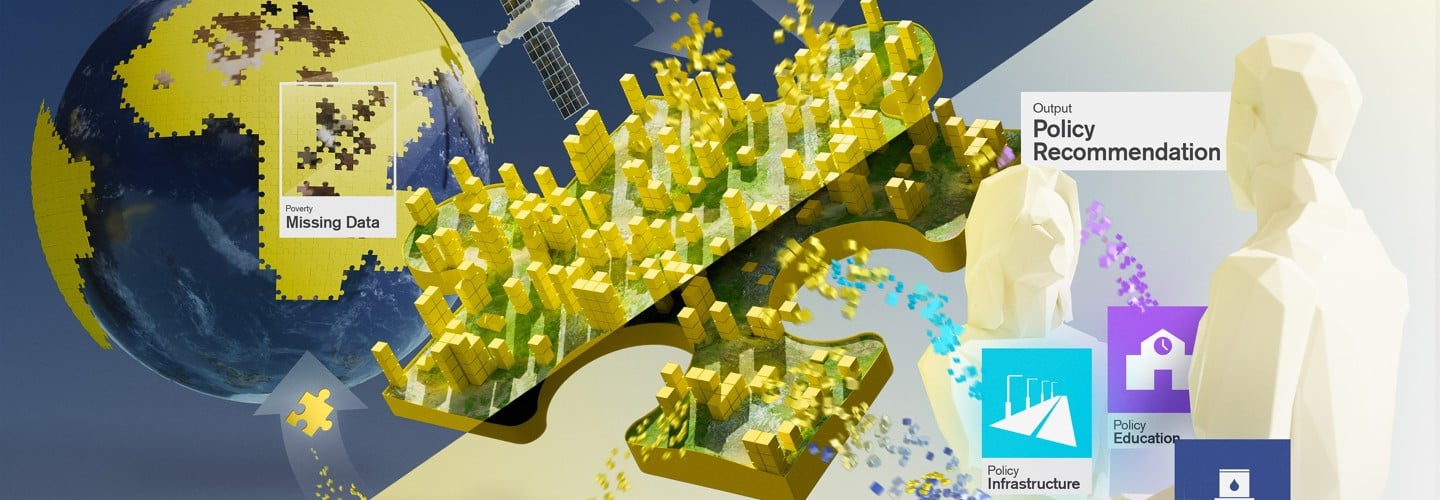
We use our data to develop AI-powered tools that facilitate decision making by evaluating the impact of past policies on development outcomes and recommending future policies. Our approach generalizes to various domains, including disaster response, monitoring constructions, and agricultural production.
By combining insights from statistics, computer and social sciences, the Lab enables more trustworthy decisions based. We aim to build software for supporting rapid and intelligent decision-making, pursuing the Sustainable Development Goals. Thus, we invite interested collaborators to join us in this pursuit.
Research team
Adel Daoud, Senior Associate Professor at the Institute for Analytical Sociology (IAS), Linköping University, and Affiliated Associate Professor in Data Science and Artificial Intelligence for the Social Sciences at the Division of Data Science and Artificial Intelligence (DSAI), within the Department of Computer Science and Engineering, Chalmers University of Technology
Mohammad Kakooei, postdoctoral researcher at DSAI
Markus Pettersson, doctoral candidate at DSAI
Connor Jerzak, Assistant Professor at University of Texas at Austin as in the Department of Government.
Xiao-Li Meng, Professor at the Department of Statistics, Harvard University
James Bailie, doctoral candidate at the Department of Statistics, Harvard University
Felipe Jordan, Department of Economics and the Institute for Sustainable Development at Pontificia Universidad Católica de Chile