Our demanding legacy
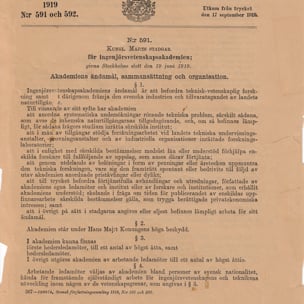
The Royal Swedish Academy of Engineering Sciences (IVA) was founded in 1919 on a foundation of technology and science—yet firmly anchored in business, working life, and social policy. The engineer was placed in a broader social context.
It was a tense time: the Russian Revolution had just taken place, and unrest spilled over into Sweden after the hardships of the war years. The labour market was fraught with conflict following the general strike of 1909, and universal suffrage was on the horizon, heralding a complete reshaping of the social and political landscape. There was optimism for peace, even though deep conflicts persisted around the world. Meanwhile, Sweden’s industrial transformation and urbanisation continued relentlessly. The world was in motion, but its direction was far from clear.
At that moment, Sweden chose a path of cooperation and consensus. It was neither obvious nor easy, but it happened—and many different forces managed to find common ground.
IVA assumed a central role in creating a coherent and sustainable societal model from the conflicting forces that emerged in the post-war period. The Academy took on the task of financing and organising technical research and, already after the First World War, channelled the results of military research into civilian applications—what we now call dual use. In practice, IVA functioned almost like a Ministry of Industry, laying the foundations for many initiatives that later became government agencies and councils for technical research and development in the post-war era. Some examples of IVA initiatives that still exist today include the Swedish Museum of Technology, the state research institute RISE, and what were first called “technology attachés” but are now known as Research and Innovation Counsils.
This legacy is a demanding one—a Swedish approach characterised by rationality and inclusion, with high ambitions to unite prosperity with fairness, leadership with participation, and national goals with international engagement. In times of uncertainty, it is crucial to know who you are, what you excel at, and what is required to embrace the new. This is nothing to fear; on the contrary, it is a Swedish speciality: daring to leave the old behind and embrace the new—not by recklessly plunging into the unknown, but by taking a considered approach and thinking broadly.