Global utblick: Asien #3
Teknikutvecklingen och innovationen i Asien är omfattande, ultrasnabb och påverkar hela världen. Nu erbjuder IVA kvartalsvisa tematiska lägesrapporter om Asien. Nummer 3 handlar om den östasiatiska robotboomen: dagens åtaganden och morgondagens utmaningar.

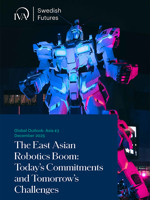
The East Asian Robotics Boom: Today’s Commitments and Tomorrow’s Challenges
The robotic future is nearly here, and East Asia stands at the forefront of this shift. East Asian firms innovating in this sector are backed in various ways by governments committed to competing for leadership in robotics. This field promises to unleash heightened productivity and precision in manufacturing, while the opportunities in services are also enormous. The expanded installation of robots, as it is unfolding in East Asia, will also bring predictable and uneven social challenges.
Leading the way
East Asia remains near the centre of both production and installation of robots. As producers of industrial robots, China, South Korea, and Japan are among the top countries, even if the region’s firms are not the outright leaders in every domain. Japan, for instance, supplied 45 per cent of the world’s industrial robots in 2022. Precision has been a competitive advantage in the country’s industrial robotics. In China, rapid robot installation has fuelled domestic production. The result is booming production. In 2024, domestic producers sold more units in China than did foreign robot manufacturers. At the start of November 2025, official sources announced that Chinese production of robots had seen nearly 30 per cent year-on-year growth.
Production of humanoid robots is also accelerating. Big firms such as Samsung Electronics have gained robotics experience, including with humanoid robots, in various areas: through building robot components, assembling finished robots, and installing robots in their workplaces. Manufacturing AX Alliance, a consortium of South Korea’s electronics largest firms, announced plans for collaboration that would lead to mass production of humanoid robots by 2029 and AI-powered self-driving vehicles by the year after.
The promise of AI integration into robotics has further fueled enthusiasm in the region for the field. East Asian firms and governments have pinned greater hopes on physical AI than on artificial general intelligence (AGI). The strong manufacturing infrastructure and competitive positions seem to place firms in this region in a strong position to reap benefits from integrating AI into automation.
Humanoid robots are set to have crucial roles both in industrial production and in services for people. Because of aging populations, East Asian countries are anticipated to be among the first places to adopt humanoid robots on a large scale.
Automation is expanding quickly in East Asian factories. Industrial robotic installations in East Asia have advanced far more rapidly thanthe rest of the world. Of worldwide newly deployed robots installed in 2024, over 70 per cent were installed in Asia compared with just 15 per cent in Europe. South Korea has one of the highest ratios of robots to workers in the world. It has the highest robot density with one robot for every ten workers. This figure is more than six times the global average, according to the International Federation of Robotics (IFR).In China’s factories, automation is accelerating. As of 2025, more than half of global robot installations are in China.
Managing the robotics transition
Loosely common features of industrial policy structure in East Asia enable the quick responses across the region. Placing catch-up growth as a top priority, governments can promise the transfer of funds into a sector that is designated as a leading one. This support can come in the forms of infrastructure development, education, legislation, and coordination. East Asian governments have the bureaucratic capacity, the ties with industry, and the political traditions to direct support this way. Governments set out medium-term plans specific to the robotics industry.
In China, state-owned enterprises are among the major purchasers of robots for installation. This demand, overseen by the party-state, creates further opportunities for domestic robot producers. This is an example of how governmental actors can help turn robot installation into a force for manufacturing of robots.
Government planning and support for the robotics industry in East Asia largely does not factor in the social consequences of introducing robots. If robots are taking over tasks that generate wealth, how will people make their living? This basic question about employment – and, at core, about the social contract – is mostly sidestepped in the heat of competing to lead the world in robotics. Unions or relevant ministries are not systematically consulted.
East Asian governments have 20th-century traditions of mobilizing for international competition without regard to social costs. Japan and South Korea gained states that excelled in industrial upgrading and building infrastructure. Social mobility followed for many people, since factories needed to be staffed. The goal, though, had been to play catch up. In China, the excesses of Cultural Revolution violence in the late 1960s delegitimized central government efforts to manage people’s welfare. Competition was embraced.
The consequence of these histories is that today’s East Asian governments often support efforts to enhance international competitiveness without the integration of protocols that consider social costs. There are few mechanisms for incorporating concerns from society into industrial policies. In the field of robotics, this pattern continues.
What about people?
Demography is frequently cited publicly as a reason why robots are needed. East Asian societies are aging rapidly. Japan and South Korea lead the wave. China still has a younger population structure but decades of low birthrates mean a sudden aging will occur. Under these conditions, robots can both assist the elderly and take over jobs left by those retiring who were not replaced through reproduction or immigration. The societies will need to replace the labour lost through aging.
Of course, demography and labour are just other words for something simpler but also more sensitive: people. The former words play down the social and political implications of robot adoption. That usage could be short-sighted.
(And why are East Asian societies experiencing demographic decline? Because the push to build competitive societies turned people against building families.)
The labour and demographic issues vary across East Asia. Even though China has emerged as a technological force and the country is home to wealth, on aggregate, the People’s Republic of China remains a middle-income economy. This point is crucial when considering the impact of robotics on employment. Rural labour has not been fully absorbed by the industrial sector. If automation reduces the need for labour, what will be the consequences for livelihoods? The question of how a large proportion of the population becomes incorporated into the modern workforce looms large. The potential for disruption is massive, especially in a society without robust mechanisms for systematically and peacefully addressing discontent.
The transformation of the Chinese workforce in the 1990s occurred without massive instability. As state-owned enterprises (SOEs) laid off privileged workers, a new cast of industrial workers was recruited from the countryside. This process enabled a gradual withdrawal from socialist planning and politics. The result, in contrast to much of the former socialist world, was a transition to a market economy with minimal political disruption. Were China to undergo another round of industrial workforce restructuring as a result of accelerated automation, the politics would likely look different. The innovations in local-level governance that underpinned the earlier transition are nowhere to be seen today. There is no reason to think that the process would be smooth.
Contrast this situation with the wealthier economies, on a per-capita-GDP basis, of South Korea, Japan, and Taiwan. Rural labour has long since been fully absorbed into the industrial workforce and service sectors. Even if productivity can be improved, that initial labour transition has already been made. The move to automation could encounter weaker backlash.
Yet the wealthier East Asian societies are not without coming political challenges. Youth unemployment and underemployment could be exacerbated by the accelerated introduction of robots. Indeed, a paradox here is that the claimed need for skilled labour exists alongside high levels of education and widespread discontent over employment opportunities.
Marginal labour
Robots also hold promise to perform ‘undesirable’ jobs, liberating people from menial or dangerous work. In East Asia, these jobs have not gone unperformed. They have been allocated instead to particular groups – often women and foreign workers.
In South Korea, Japan, and Taiwan, governments have created legal structures for firms to hire workers from overseas at a discounted rate. China has not seen this to the same extent. Japan has had greater resistance to bringing in such workers, but in South Korea and Taiwan they are now crucial in large parts of the economy.
Robot adoption in these societies could first take jobs done by foreign workers. In the short and medium term, this would put the pain first on these vulnerable categories. They would be sent home and the process would have minimal political impact. Furthermore, this dynamic could avert potentially awkward discussions about greater incorporation of foreign workers into these societies (as a politician in the United Kingdom has suggested for that country).
In China, this ‘buffer’ role of marginal labour is performed by Chinese. That fact changes can make industrial robotics adoption more sensitive.
Pressure for social and political innovation
The looming social challenges as a result of robotics adoption are systematically disregarded in the face of fighting for a competitive edge. Instead of formulating staged rollouts or phased adoption plans, the problems are kicked down the road.
The imperative of competition is cited as reason for turning rapidly to robots and physical AI as a solution for local and national economies. Without it, countries such as South Korea might lose any manufacturing edge to China or another economy.
Social and political innovation will be needed to handle these situations to prevent crisis. South Korean President Lee Jae-myung has long championed universal basic income schemes; such proprosals could be part of an innovation.
Countries in East Asia are differentially placed to deal with these challenges. Innovation in the social sphere takes openness and feedback mechanisms. South Korea and Taiwan stand ahead as leading democracies in the region, even if each faces a serious national security challenge. They have lively civil societies that respond creatively, as well as competitive electoral politics. These features can create openings for innovation while weeding out those who fail to propose solutions.
Japan is also a democracy, yet of a less lively sort. Politics there revolves around intra-party negotiations within the usually-ruling Liberal Democratic Party. Conduits for new ideas and voices to gain expression seem few. Citizen action through protest or other forms of demand-making is also weaker.
In China, sources of future social innovation are even fewer. The early era of reform from socialism was based on experiments, often locally led, which were assessed and then, if deemed successful, more widely adopted. That period is now in the past. There appears to be a distinct absence of the flexibility required for finding and trying out new ideas for organizing society.
Conclusion
National competition drives governmental support in East Asia for robotics development and adoption. The conditions for integrating robotics smoothly into society vary within East Asia. As a developing country, China’s foray into robotics risks excluding a huge portion of the labour force from the most productive economic activities. In the wealthier East Asian societies, marginal foreign workers are poised to bear some of the intial blow, making citizens more amenable in the short term. In all of these countries, the robotics push exposes the contradictions of having aging populations, overeducated youth, and growing unemployment.
The technological innovations behind leaps in robotics are impressive. Staving off social crisis stemming from them will require similarly impressive innovations in the social and political realms.
/Hyejin Kim och Erik Mobrand för Kungl. Ingenjörsvetenskapsakademien (IVA)
Hyejin Kim är forskare vid Institutionen för ekonomisk historia, Lunds universitet, samt biträdande professor vid Institutionen för statsvetenskap och programmet för globala studier, National University of Singapore. Hon har skrivit fem böcker och hennes forskning fokuserar på utbildning, globalisering och vetenskapspolitik.


Om Global utblick: Asien
Teknikutvecklingen och innovationen i Asien är omfattande, extremt snabb och påverkar hela världen. För att öka kunskapen erbjuder IVA nu kvartalsvisa tematiska lägesrapporter om Asien, författade av sakkunniga forskare med omfattande regional erfarenhet, under rubriken "Global Outlook: Asia".
Originalspråket för utblickarna är engelska.