Global utblick: Asien #4
Teknikutvecklingen och innovationen i Asien är omfattande, ultrasnabb och påverkar hela världen. Nu erbjuder IVA kvartalsvisa tematiska lägesrapporter om Asien. Nummer fyra handlar om Sydkorea, som tack vare sin halvledarindustri nu har en betydande förhandlingsstyrka i relation till de största AI-företagen.

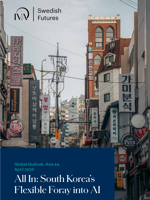
All In: South Korea’s Flexible Foray into AI
In subverting the choice between accommodating the global AI industry and building AI independence, South Korea offers examples of creative possibilities in technology policy.
In October 2025, NVIDIA CEO Jensen Huang stopped in Seoul for a fried-chicken-and-beer afterwork with the bosses of Samsung Electronics and Hyundai Motor Group. The next day he met with South Korean President Lee Jae-myung, who confirmed the purchase of 260 000 graphics processing units (GPUs) from Huang’s firm. A good bit of business and one that signalled the East Asian nation’s commitment to the AI industry.
South Korea has recently made deals with the largest AI model firms, too. OpenAI’s Sam Altman visited Seoul in 2025 and ordered chips from Samsung and SK Hynix, the global semiconductor giants based in Seoul; the chips companies are in turn planning data centres for OpenAI in the country. In late February 2026, South Korea approved Google’s use of detailed map data in part because of anticipated growth in autonomous vehicles. The embrace of major American AI players appears thorough, and all the more remarkable in an economy that often resists foreign technology firms.
Yet this receptiveness is only half the story: The South Korean government is simultaneously working with domestic industry toward achieving national independence in AI, also known as sovereign AI. Here is a potentially fascinating case study of technology policy moving boldly, flexibly, and in an open-ended way in two opposing directions at the same time.
Whether the approach has flaws or not, the experience speaks to big questions about the possibility of ascending the costliest parts of the AI value chain and about the terms on which ambitious nations negotiate with leading firms. For Europe, South Korea’s flexible foray into AI illuminates technology policy options in AI and well beyond.
“Rebellious” startups
South Korea industrialized by learning how to mimic leading firms in a given sector and then outperforming them. The country is hardly alone in pursuing such a strategy; China has done so more recently. It is reasonable to expect that in AI South Korea – or China, for that matter – might take the same approach. The trouble, beyond technical difficulties, is scale. Design and production of GPUs requires a scale that can rarely be met. Rivaling NVIDIA in the GPU space looks like a quixotic task. Joining OpenAI, Microsoft, Meta, or Google in the foundation model building game looks equally daunting. South Korea might just have the technical chops, but achieving the financial scale to launch challenge seems unlikely.
Little wonder, then, that two of the promising and ambitious Korean AI startups have names that shout “revolution.” FuriosaAI is named after a character who takes on authority in the post-apocalyptic Mad Max film series. The other firm is called simply Rebellions. Both startups design neural processing units (NPUs) that specialize in inference rather than training. They are both among the newest of South Korea’s two dozen unicorns.
Rebellions explained to Global Outlook that their chips operate with greater energy- and cost-efficiency than GPUs. The firm sells its NPUs – installed inside servers manufactured in Taiwan – to data centres with the message that they can help keep costs down and thereby open the way to profits. The product is not identical to NVIDIA’s, but the target markets overlap significantly.
Startups in South Korea work in an environment influenced by a firm with a powerful global presence across the chip value chain. Samsung Electronics has developed specializations in multiple related areas – from top-end memory production to logic manufacturing and chip design. Samsung’s competitors operate mostly in just one of these domains. As a result, South Korea has an extraordinarily high degree of leverage in the AI field. This position shapes the options available to startups.
Founded by Korean engineers who cut their teeth in American tech firms, Rebellions credits its design success partially to the strong semiconductor industry in South Korea.Owing to the global positions of Samsung and SK Hynix, the country has a wealth of electrical engineers and computer scientists who have gained leading-edge knowledge from their work experience. Rebellions did not need to be in Silicon Valley to build a workforce.
Collaboration with large domestic firms has proved crucial for South Korea’s AI startups. The chip companies have been partners and investors for the startups. The country’s telecommunications firms have provided both investment and testing opportunities. Rebellions gained insights and credibility from opportunities to install its products in data centres belonging to KT, one of the major telecom firms. These forms of support come from private entities, but they perform functions that have elsewhere been public, such as when the US government acquires technology from promising startups.
Government support
The network of partnerships cuts in complex ways. The chip foundries, Samsung and SK Hynix, work with Korean startups but also with the American chip and model firms – even as one set of partners aspires to challenge the other. The telecommunications firms and university research centres are also involved in both directions.
This flexibility is reflected also in the South Korean government’s approach. The government has shown it is fully supporting the country’s integration into the existing AI value chain, while also deploying a series of tools for fostering innovative and ambitious local firms to insert themselves in the top end of this chain. Sovereign AI is declared as the goal. This goal justifies a number of initiatives that have supported domestic startups.
Seed funding, testing, and competitions have been among these initiatives. The Ministry of Science and Information Technology (MSIT), for example, is eager for Korean firms to build AI chips and has provided valuable real-time testing opportunities for startups. The Ministry of Ventures and SMEs has offered funding programmes for deep tech startups.
Now firms like Furiosa and Rebellions are attempting to break into foundation models. The government currently runs a competition to develop foundation models. The mission is to develop domestic AI technology independence through models that can be widely used across areas such as law, manufacturing, defense, healthcare, and finance. The shorter-term goal is to build AI models achieving at least 95 per cent of the performance of the latest global models released within the past six months.
In 2025, the government selected a set of elite consortia that compete for performance within this initiative. Each consortium is composed of universities, research institutes, and corporations. The teams were selected based on their commitment to developing sovereign AI, open-source policies, and ambitious technical expansion. Initially, 15 teams applied, and five teams were selected. The teams were given access to GPU clusters for their development work and other support such as wage subsidies. In March 2026, an expert assessment resulted in three of the consortia continuing to the next round (with a four consortium to be added). Furiosa and Rebellions sit on rival teams. By 2027, two teams will have a chance to remain as finalists. There is no foregone conclusion that any Korean firm will win further government support, as consortia are expected to meet the high technical criteria and the requirement that models are trained domestically from scratch. Finalist teams will gain access to contracts thought to be worth in the hundreds of millions of US dollars, in part because the purpose is to build models that can be used in sensitive government work.
Geopolitics, dependence, and integration
By supporting ambitious startups and courting the AI giants, the South Korean government ensures that the country will assimilate the new technology, even in the event the moves to build its own AI infrastructure falter. While many domestic actors, both public and private, show little hesitation with this strategy, the global firms have noticed that there is a battle beneath the surface. OpenAI released a proposal asking South Korea to step back from sovereign AI ambitions, while offering the country a prominent place in OpenAI’s global growth.
An interplay of geopolitical concern and pursuit of economic opportunity shapes Korean engagement in the AI sector. On one hand, there are the chances for innovation and gaining market share. On the other hand, there are the risks of fostering dependence on external firms and countries. These risks and opportunities are combined and shared by both government and industry, rather than divided. Government can support industrial upgrading, while firms offer products that are seen as mitigating geopolitical risk. It is intriguing also that the AI giants are not treated primarily through the lens of regulation but in relation to national economic strategy. Put another way, authorities frame national interest vis-à-vis these global firms in the proactive terms of strategy rather than excusively in the reactive terms of regulation.
Korean firms such as Rebellions bill geopolitical independence as a selling point. This positioning has attracted both investments and a customer base. Many countries find the choice between the United States and China too sensitive. An option that is not China and not the United States is therefore attractive. In Saudi Arabia, for instance, the regime is reluctant to use the generative AI models built by American firms for linguistic and political reasons. South Korea is a desirable alternative. In other words, concerns about dependence can themselves become a technique for raising funds and building markets.
Concluding thoughts
Due to its semiconductor industry, South Korea arguably holds exceptional leverage when dealing with the biggest AI firms. Even then, it remains far from certain at this moment that Korean firms will make the breakthroughs, both technologically and in sales, to contribute to sovereign AI. The country is worth watching in the coming months and years for lessons, possibly both positive and negative, about the pursuit of national technology strategy under conditions of pressure for both integration and independence.
Regardless of future developments, South Korea’s experience up to early 2026 highlights a set of possibilities that are sometimes obscured in other contexts. As Sweden and Europe consider their technology futures, the record of a fellow innovative democracy in another region can only enrich policy discussion. In South Korea, as in Sweden, minimizing dependencies sits as a goal alongside ensuring integration of leading technologies. These are the main lessons from South Korean efforts to manage these challenges:
- Flexible and pro-active policymaking can ensure that a country integrates leading technologies while also supporting domestic industry’s efforts to break into those technologies. Risks can be dampened by pursuing multiple strategies and by making private sector support performance-contingent. This form of risk management permits ambitions to remain high.
- Divisions between public concerns about geopolitical risk and private aspirations for innovation need not be so rigid. Geopolitics and risk of dependence have traditionally been imagined as falling within the purview of government, while the advancement of technology belongs to the realm of business. That separation, if it ever stood, is obviously breached today. Acknowledging the breach can only help nations grow more prosperous and secure. Governments can take on more strategic thinking in technology, while firms can find opportunities in geopolitical signalling.
- Existing industrial and skill bases can be repurposed to gain entry to and build competitiveness in advanced fields. Private and public actors can draw creatively on existing domestic strengths. Strategic cooperation between established enterprises and tech startups can support movement into higher value-added areas of a production chain.
/Hyejin Kim och Erik Mobrand för Kungl. Ingenjörsvetenskapsakademien (IVA)
Hyejin Kim är forskare vid Institutionen för ekonomisk historia, Lunds universitet, samt biträdande professor vid Institutionen för statsvetenskap och programmet för globala studier, National University of Singapore. Hon har skrivit fem böcker och hennes forskning fokuserar på utbildning, globalisering och vetenskapspolitik.


Om Global utblick: Asien
Teknikutvecklingen och innovationen i Asien är omfattande, extremt snabb och påverkar hela världen. För att öka kunskapen erbjuder IVA nu kvartalsvisa tematiska lägesrapporter om Asien, författade av sakkunniga forskare med omfattande regional erfarenhet, under rubriken "Global Outlook: Asia".
Originalspråket för utblickarna är engelska.